




Conductor Vimbayi Kaziboni: How do we do what we do and still represent who we are ?
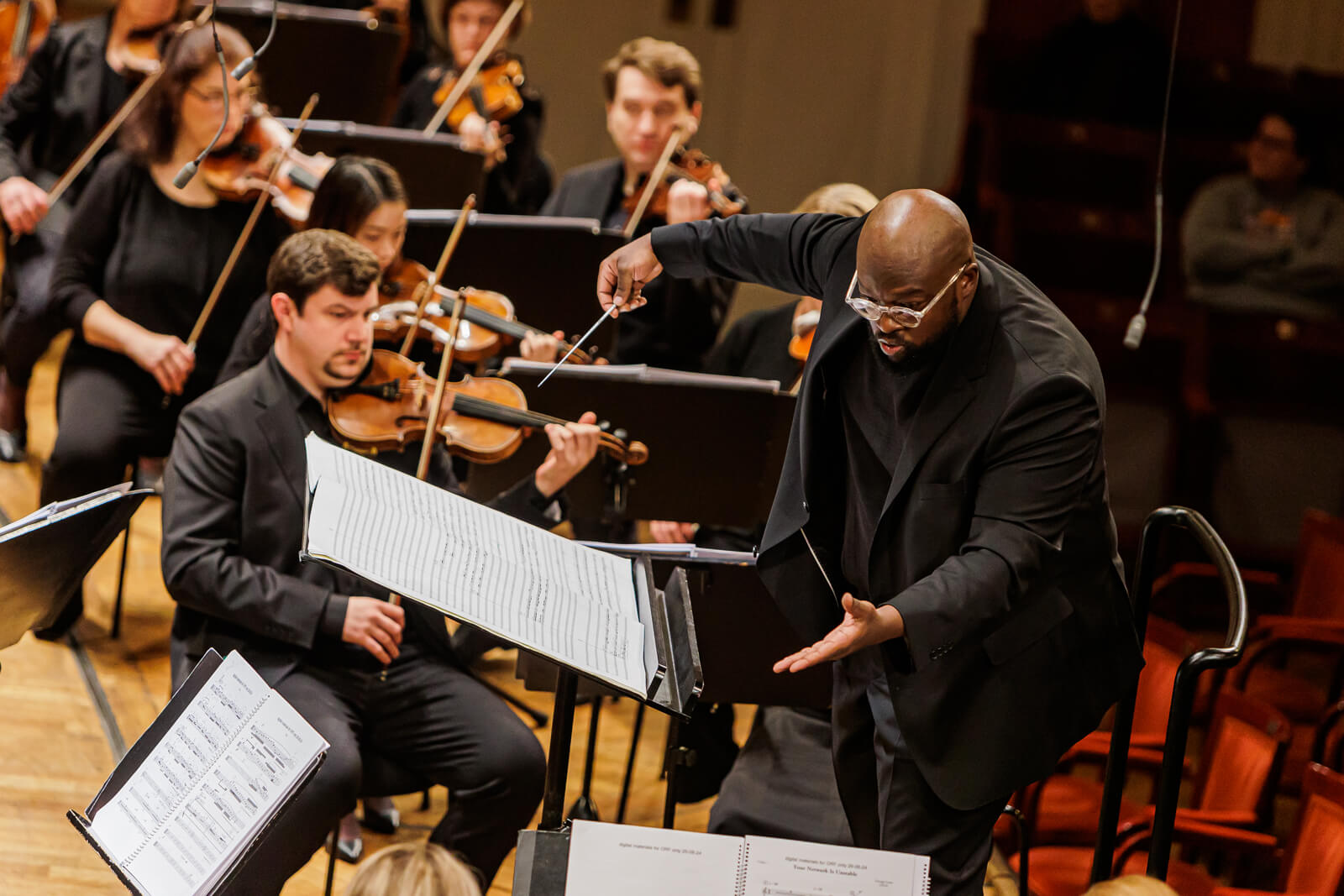


What music can be discovered in a growing, increasingly diverse metropolis? Which stages reach which audiences? Who stands on these stages, and who does not? These were the guiding questions during this 38th edition of Wien Modern, the viennese festival of contemporary music. One of the major answers came from the work of Zimbabwean Vimbayi Kaziboni, the conductor of the sold out opening concert of this festival. Prior to this event, we met Vimbayi Kaziboni and had a great exchange with him on Identity and inclusion in contemporary classical european music.
–
He prefers to speak about others rather than himself. He continues to view himself as a lifelong learner in a constantly evolving musical world. Equally at home in African musical traditions and Western classical music, he embodies a unifying spirit. A conductor who delights in asking profound questions, he feels deeply at ease in Vienna, where he resides, and sees himself as a bridge between diverse musical genres. With unwavering optimism about the role of civil society in transforming today’s world, he stands as a quiet poet of classical music in motion. An Interview with Vimbayi Kaziboni by simon INOU.
Can you please introduce yourself ?
I am Vimbayi Kaziboni, I’m an orchestra conductor. I was born in Zimbabwe and grew up in Harare and I moved to the USA. Likewise, I studied there then in Germany and France. Now I live and work with orchestras here in Vienna.
As an african I would like to know what your name mean
Vimbayi means Hope. Kaziboni is difficult to know. The prefix Ka is a diminution of something. The next part is Zi makes something bigger. So that’s why it is difficult to know what my name means.
Can I interpret it as a kind of balanced hope?
It’s kind of balanced, I suppose. Small and big. I would have to go ask my family members more about this, but we know that we don’t know. We know that it is a paradox.
You live in Vienna. How does the city influence you personally and the music you create?
Vienna is the mecca of classical music. Beethoven was from Germany, but he came to Vienna, Mozart was from Salzburg, but he came here to Vienna. It was important to all those composers to come and make their musical lives in Vienna. I have been very lucky enough to be invited and very accepted here musically. It is one of the happiest periods in my life, with regard to the balance of my personal life and my work. Vienna has been a very welcoming place in this regard.
You are a conductor. Can you please explain what a conductor is and does ?
The conductor is the chief musician among a group of musicians. He is the person who leads, who accumulates the artistic interpretation of all the musicians in front of them and makes it into one accord of ideas. In French, it’s chef d´orchestre. A chef. You are putting all these ingredients together, and it’s not just about ingredients of music, but also about ingredients of our own humanities. Everyone’s voice should be heard. This is all part of what the conductor’s calling is. So over time you accumulate all this knowledge and that’s how you find a voice for yourself. You find an identity for yourself musically.
Finding an identity as an African, what does that mean in European classical music?
That’s a very difficult question because it’s one in which we have to invent. I must say I don’t have that many mentors in this regard. In fact, my mentors as it regards to African identity, are not conductors. For example, one of my biggest mentors and great heroes, George Lewis, is a composer, a trombonist, a musicologist, and sociologist, not a conductor. I have to ask myself this important question, how do we do what we do and still represent who we are? My big conducting mentor was a woman, a lesbian woman in fact. Dr. Lucinda Carver. As I was studying with her I learned a lot about her life, about how she also fought for her career, about all the successes and challenges, about how to really represent who you are and how to be truthful to yourself in public and leadership positions, especially considering there are not many people before you. So a big part of it is inventing yourself, finding your own grounding, listening to others, observing others and in the end you will find your way.
Is it easy in this case to find a way ?
Of course not, it requires love, soul-searching – therapy. In the end, it’s possible. It’s not easy, but life is not easy for anyone in any walk of life. I think that one has to bring a lot of humility to this kind of work and kind of thinking about yourself. In the end, you have to be true to yourself, true to what you love, to what you represent and hope for the best knowing that people will welcome you and sometimes they won’t. You have to have the courage to keep fighting and to keep going despite all the challenges.
Do you identify as a black person ?
Yes, above all, because it’s not just that I identify myself as a black person, it is that everyone else identifies me as a black person. So there’s not really an option. So the good news is if you can take that identity and embrace it yourself, rather than how other people look at you, that’s of course the best way to go.
Are there any Black musicians you consider your heroes?
Yes of course, my biggest artistic hero is Nina Simone because of her music certainly, but also because of the struggle of her life. She identified herself as she saw herself and not as others saw herself. Sometimes those identities may collide. Sometimes they may intersect, sometimes they may collide. I identify myself in every room that I am working in as a black person and I want to celebrate that I’m a black person. I feel that I cannot be understood if I don’t really champion my identity.
You work in the field of contemporary classical European music, do you think Africa is part of that ?
Whether it is or not, it has to be part of that. Contemporary classical music is a Western phenomenon. During the height of the classical period in the 17th century in the west, not many people like us black people were part of western europe. But you could find some black composers in France or the UK. So it was difficult then to look at the western musical canon with black identity. However, the world we’re living in today is very different. It means that a different story has to be told. It means that different identities have to be championed because we’re living in a much more global.And this is what the challenge of contemporary classical music is about. It has to do with more voices and has to champion those more voices. We have to look at the lineage of Beethoven, not simply as this lineage of white European men, but rather as a lineage also linked to European imperialism in the world. Therefore at some point it has to reflect everybody and this includes people like you and me. My own mission as it comes to my work in contemporary classical music is to ask this fundamental question: am I championing as many voices as I can? Whose voice do I not know? Who am I not including?
How do you do it with African music ?
With my mentor George Lewis we are working on a project called Afromodernism in contemporary music. We started it in Frankfurt in Germany with a symposium and concerts with Ensemble Modern. The project has taken many iterations since then including one entitled “Composing While Black”
What was it about?
It was a retrospective of black composers from all over the world. Not just black composers in that they are racially black, but also in many different aesthetic directions. Another important thing is that black people are not just playing blues music. And it’s not just folklore. In this project we’re trying not to caricaturize what a black person is, but rather to open up to aesthetics that have existed but were little known.
Some examples ?
The first person that comes to mind is a composer named Andile Khumalo whose work I admire greatly. He’s a black composer from South Africa, who utilizes African materials like xylophones, flutes and pipes in his work. However, he writes in the style of French spectralism, in which essentially when you play one note, there’s a very complex analysis of this one note. Few will believe that this is coming from Johannesburg, and from a very deeply rigorous intellectual approach to making music in the 21st century. He does this, and somehow retains his Africanism. Hearing his music let me think of French spectral composers like Grisey and Murrail with their very abstract music with spectral aesthetic. There are many of them. A summary of many you can find it in the book with the title “Composing While Black: Afrodiasporic new music today.
Recently, several Black orchestras—like the Black Orchestra Network and the Chineke! Foundation—have formed to promote inclusiveness in classical music, where Black musicians remain underrepresented. Do you agree with this mission?
Yes, it’s a fact that black people are less represented in classical music. But the question is what can we do about it?
What can we do as black people or …
No, what can we as society do about it? When it comes to issues of oppression and exclusivity, it’s not the victim’s role to make amends. It’s in my view the perpetrator’s role to make amends. But if they don´t want to then we have to take it on ourselves to make amends. Look, in South Africa, the fight against apartheid required other people to cosign. Otherwise, there’s no way of just doing it ourselves. Of course, we die trying. There’s no doubt. But it requires everyone to participate in these struggles.
At the beginning of your answer above, you spoke about a WE. Who do you mean by “we” ?
“WE” is everyone in my view. And I’m very proud of what Chichi did with the Chineke orchestra in the UK. Fourteen years playing in the best orchestras in the UK, and she can count on a single hand how many times she played with other black people. That feels very tragic. How alone must you feel? You feel so alone living life like this. And what does she do? She found collaborators. She found people she could collaborate with, also convinced people in power, which is mostly white people that her mission was critical. She collaborated with them and started this incredible, powerful project. And I think that’s the collective “WE” I mean.
But why do only black artists have to do the work and not the white artists ?
In my country, Zimbabwe, formally Rhodesia, why didn’t the white Rhodesians say let’s be fair and give the land back to the black Africans? I think there’s a very obvious similar parallel. Firstly, sometimes it doesn’t come to them in an intuitive way. That’s number one. It’s about power isn’t it. I think it’s a tragic assumption that the more inclusive you become the more power you lose. This is something that you see very often, that people are afraid to lose power. People want to hold on to power. That’s very tragic. So I would reckon maybe there’s a parallel here with what we’re talking about with orchestras all over the world.
But how do we challenge that as a society, as a WE ?
It requires people coming in with good faith, people who are self-critical, self reflexive. People who look at what we are doing, and how this serves our society and more directly out own communities.
Why do you think it’s like that? Why are they opening now? Why didn’t they open before?
It’s because of what we’ve been seeing in society in the last few years. George Floyd’s death really opened up conversations in many aspects of society that would have never been thought of, including classical music of all places.
The Black Lives Matter movement …
Yes, the Black Lives Matter movement played a great role in this regard. The events of the last five years have been so groundbreaking in many fields. And classical music is no exception.
Are you not afraid that the movement that started five years ago will disappear with the arrival of Donald Trump in power ?
I don’t think so. I think that when things get bad is when people who are really inspired and care about these topics get invigorated and do the work that is necessary. It feels obvious to me that there has to be a much higher degree of resistance. Now more than ever because things feel more urgent. So for now I remain optimistic.
How can classical music be more influenced by African music ?
I can name many classical composers whose work is deeply influenced by African music. Let me start with the American minimalist composer Steve Reich, known for his groundbreaking minimalist style. In the 1970s, he traveled to Ghana to study traditional drumming, and this experience inspired his celebrated piece Drumming. His most famous work, Music for 18 Musicians, is also rooted in African rhythmic structures.
Another major figure is the Hungarian composer György Ligeti. In several of his compositions, you can hear the influence of African drums and rhythms woven into his complex textures. There are also many composers of African descent making profound contributions to classical music. Some notable names include:
- Joshua Uzoigwe (Nigeria)
- Bongani Ndodana-Breen (South Africa)
- Tania León (born in Cuba, now based in the USA)
- Composers such as Hannah Kendall (U.K.) and Jessie Cox (Switzerland)
These composers engage with African musical traditions in deeply meaningful ways, and it’s important that more people become aware of their work.
When are we going to watch you conduct the work of an African composer in Vienna?
Soon enough. We’ll be doing Andile Khumalo’s Piano Concerto soon. Just last week I was in Cologne in Germany, and we did a brand new piece of his for orchestra. So it’s a matter of time. A big part of my work with Klangforum Wien is particularly in this regard, championing new voices.
Where do you see yourself in five years ?
Well, I suppose doing more of what I’m doing, doing the work that I love at much bigger scopes. But right here in Vienna, I feel that I can already see the impact of the work I’m doing. I can see the impact on a day-to-day basis. I’m extremely excited about the musicians that I’m working with here in Klangforum Wien. These are the best musicians in the world for the work that we do and they are very inspired people who want to be agents of change, and who really believe in art and not just about its aesthetic properties, but what its impact in the world can be. So I’m very lucky to have really great partners and I see myself in the near future just doing more and more at bigger and bigger scopes.
Thank you so much.
My pleasure.
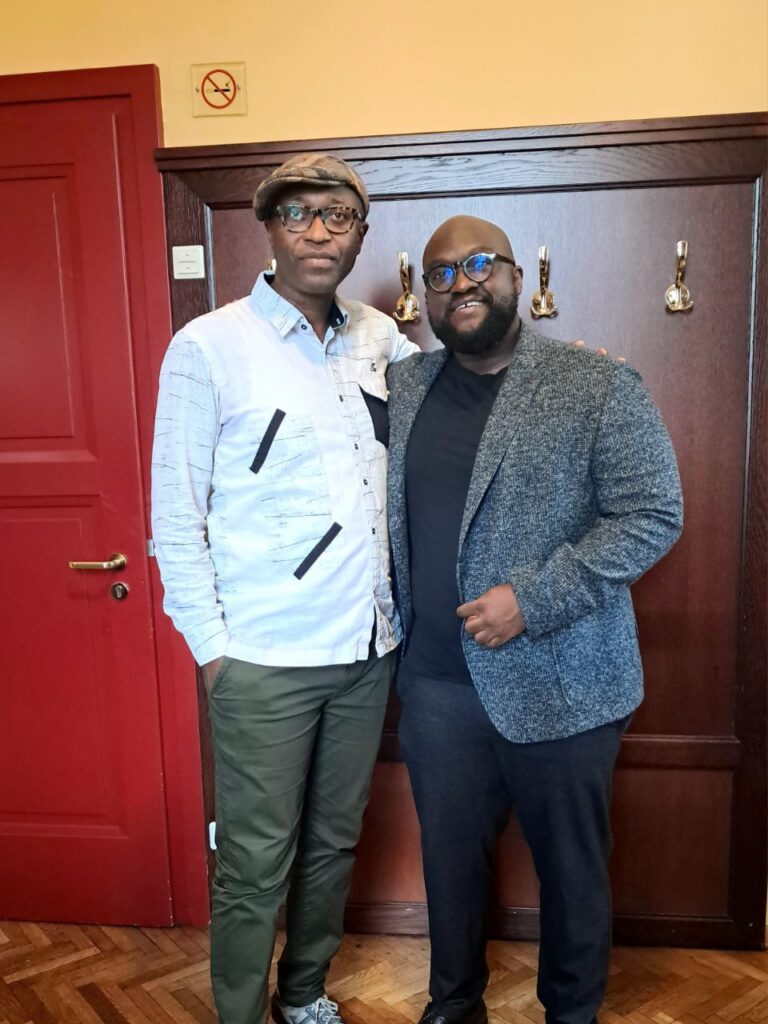
Vimbayi Kaziboni
with simon INOU